Irrationality, Infinity, Pythagoras Theorem and a Proof.
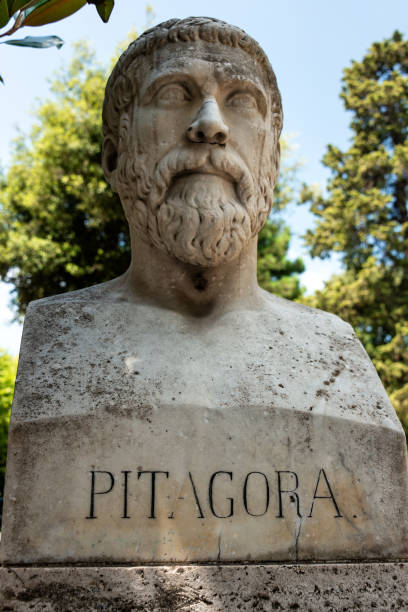
"The diagonal of a square is incommensurable with the side, because odd numbers are equal to evens if it is supposed commensurable." Aristotle in Prior Analytics.
The above quote is from Aristotle in his work Prior Analytics. This is one of the earliest mentioned example of the concept of irrational numbers namely numbers which are not commensurable with natural numbers. The diagonal of a square cannot be expressed as a whole unit multiple of a common unit of measure of the side and the diagonal.
What does this have to do with Pythagoras Theorem? If the two sides of a right triangle are both equal to a measure of 1, then the hypotenuse has a measure equal to the square root of 2 which the ancient Greeks referred to as an irrational number.
Pythagorean triples, which are natural numbers a,b,c such that the sum of squares of a and b equals the square of c, have been known well before Pythagoras by the Babylonians as early as 1800 BCE. Such triples were also known in ancient India and China. But the Babylonian mathematicians or their Asian counterparts only studied such triples restricting themselves to natural numbers. So it was the Greeks who were the first to be concerned about incommensurable numbers ie irrational numbers.
The quote by Aristotle above seems cryptic. But it is also one of the first examples of a "proof." Without the advantage of Algebra and symbolic representations, the Greeks wrote their proofs in words and sentences. I will leave it to you to figure out what the heck Aristotle is talking here about odds and evens.
Okay. Here is a link which unrolls Aristotle's cryptic statement into a formal proof originally attributed to Pythagoras himself. You can see it is a proof by contradiction that an even number and odd number are equal. https://www.tau.ac.il/~corry/publications/articles/Narrative/notes/aristo.html
I included infinity in the title of this post. What about it? Irrationality and infinity are connected. The decimal representation of an irrational number is never ending and non repeating. This again was the first encounter of what the Greeks call "actual" infinity as opposed to "potential" infinity which to Greeks meant endless repetition. The discovery of actual infinity caused a crisis in the Greek world and they dealt with it by discovering the concept of a proof. Working with infinity means that enumeration is not possible so proofs were invented.
We all know Euclid who introduced Geometry to all of us with his "Elements." But Euclid also had chapters on numbers in his famous work. In one of these chapters he introduces his eponymous algorithm, the Euclidean Algorithm. This algorithm is used to test if two numbers are relatively prime, i.e. their greatest common divisor is 1. What if you start with two incommensurable numbers such as square root of 2 and the number 1. The Euclidean algorithm will run forever, i.e. it won't terminate. The Greek connection between irrationality and infinity using Euclid's algorithm.